


The nervous system doesn’t perform
There’s a quiet expectation many people carry into a sound bath—the sense that something should happen, that there should be a noticeable shift, a feeling, a reaction they can point to when it’s over. We’re used to measuring experiences this way. If something is effective, we assume we’ll feel it. If something matters, it should register clearly.
So when a session feels neutral—or even uneventful—it’s easy to wonder if it worked at all.
But sound healing doesn’t operate on that kind of feedback loop.
Your nervous system isn’t trying to create an experience for you. It’s not performing, not trying to impress you or give you something to report afterward. It’s simply responding—quietly, continuously, and often beneath your conscious awareness. You may not feel a release, or a sense of calm, or anything you can name. And still, something can be shifting.
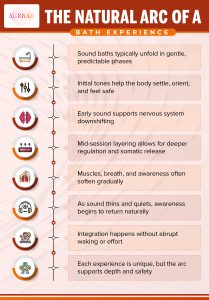
Not all change is sensory. Some shifts are obvious—emotion rising, the body softening, a clear sense of relief. But many are far more subtle. The breath may deepen without drawing your attention. Muscles may release gradually, without a single defining moment. The nervous system may begin to move out of its usual level of activation without announcing that it has done so. These changes don’t always register as an experience, but they are still meaningful.
It’s natural, in those moments, to check in with yourself. To wonder if it’s working, or if you should be feeling more. But that kind of monitoring keeps the mind engaged and pulls you back into effort. The system doesn’t need to be observed in order to respond. In many cases, it works more easily when it isn’t being watched at all.
And just because you didn’t feel something in the moment doesn’t mean nothing happened. Often, the effects of a session show up later, in ways that are easy to overlook. A slightly different reaction where you might have been triggered before. A pause where there used to be urgency. A sense of steadiness that wasn’t there previously. These shifts don’t arrive as dramatic moments, but they reflect a real change in how the system is functioning.
It’s also important to let go of the idea that feeling more means getting more out of the experience. Some people register change through strong sensation, while others shift more quietly. Neither is better. Neither is more effective. There isn’t a correct way for this to feel.
There’s nothing you need to produce. You don’t have to relax on command, access emotion, or create an experience for yourself. This isn’t something you make happen. It’s something your body responds to, in its own way and in its own time.
The work of sound is often gradual. It builds through repetition, through small and consistent changes in how the body experiences safety, tension, and release. Not every session will feel profound. Not every moment will stand out. But that doesn’t mean it isn’t working.
If you didn’t feel anything, you didn’t miss it. You don’t need to go back and try harder or do it differently. You can let the experience be exactly what it was.
Because sometimes the most important shifts are the ones you don’t track—the ones that don’t ask for your attention, but quietly begin to change how your system responds over time.
You don’t have to feel it for it to work.
You just have to let it.
If your mind doesn’t slow down easily…
this is where your system learns how.