

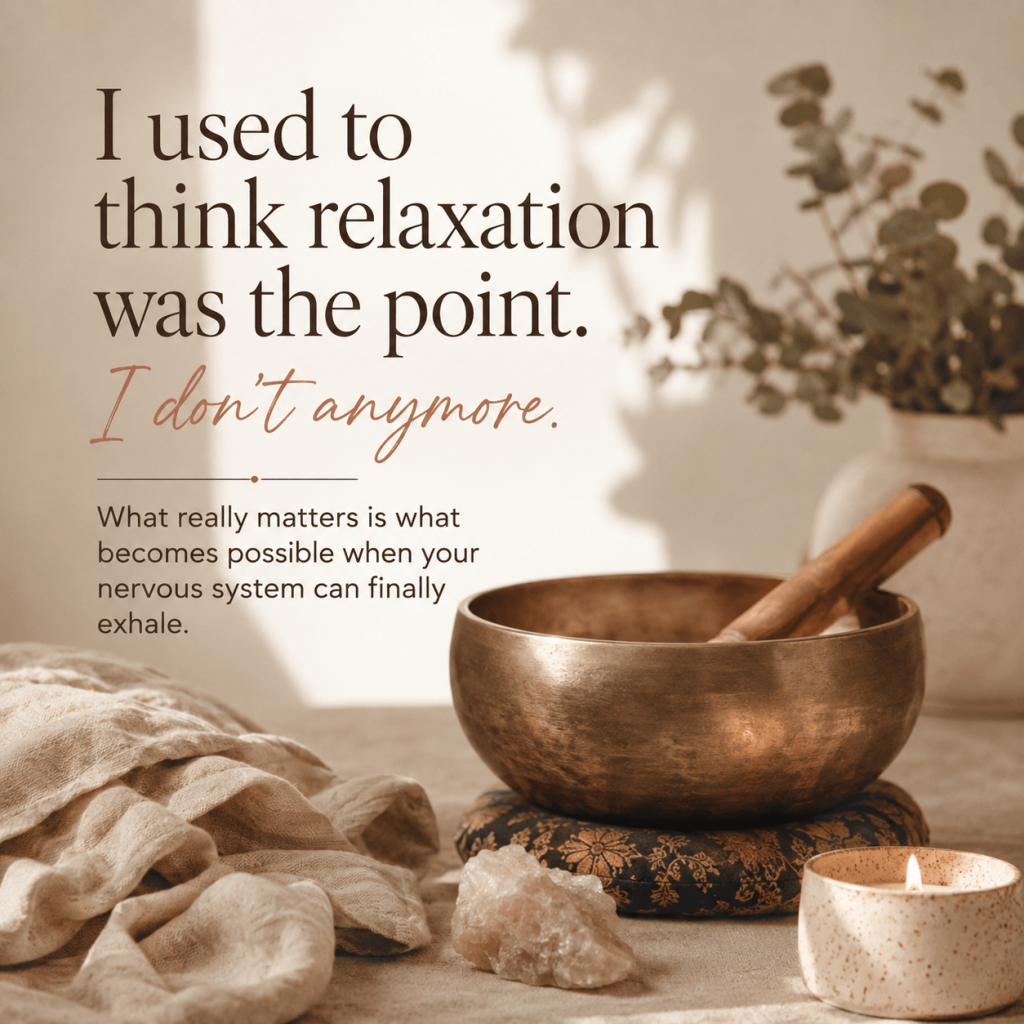
When I first began working with sound, relaxation seemed like the obvious goal. In fact, it was one of the primary pillars taught in my first sound therapist certification clprogram.
People came into a sound bath carrying full schedules, busy minds, tight shoulders, and the accumulated stress of everyday life. Then the bowls would begin, the room would grow quiet, breathing would slow, bodies would soften, and people would leave telling me how relaxed they felt.
It was easy to think: This is what sound healing does.
And relaxation certainly matters. Most of us spend far too much time moving through our lives with some degree of tension humming beneath the surface.
But after years of sitting quietly with thousands of people during sound baths, I began noticing something that changed the way I understood what was happening.
The relaxation wasn’t the most interesting part.
It was what sometimes became possible because they had relaxed.
I Began Watching People Come Back to Themselves
I’ve watched people arrive carrying the unmistakable energy of holding it all together. They may not describe themselves as particularly stressed. They’re functioning. They’re working. They’re taking care of people. They’re getting things done.
But the body often tells a different story.
A jaw stays tight. Shoulders remain slightly lifted. Breathing stays high in the chest. The body seems unable to completely settle, even when there’s nothing immediately demanding its attention.
Then, somewhere during the experience, something changes.
Sometimes there’s a long exhale. Sometimes the shoulders visibly drop. Sometimes someone’s face looks completely different afterward. And often people describe something that goes beyond simply feeling relaxed.
They feel clearer.
They feel more present.
They feel emotional without knowing exactly why.
They suddenly recognize how tired they’ve been.
They become aware of something they’ve been ignoring.
Or they simply say, “I feel like myself again.”
Those are the moments that began changing my understanding of this work.
The Nervous System Changes the Conversation
The more I learned about the nervous system, the more these experiences began to make sense to me.
Our nervous system is constantly taking in information and making adjustments designed to help us respond to life. Much of that happens outside our conscious awareness.
When stress becomes chronic, the body can become accustomed to mobilization. We may continue functioning remarkably well while carrying muscle tension, shallow breathing, hypervigilance, emotional reactivity, difficulty concentrating, or a persistent sense that we need to keep moving.
Eventually, that state can begin to feel normal.
That’s one reason simply telling ourselves to relax doesn’t always work. Relaxation isn’t purely an intellectual decision.
The body needs enough cues of safety to begin releasing some of what it has been holding.
Sound can be one of those cues.
Rhythm, vibration, repetition, focused listening, reduced external demands, and the simple experience of lying still can shift attention away from constant problem-solving and toward internal sensation. Breathing may change. Muscles may soften. The relentless mental narration can become quieter.
And when the nervous system isn’t working quite so hard to monitor, anticipate, manage, or protect, something else becomes available:
capacity.
Maybe Capacity Is the Point
This is where my thinking about relaxation changed.
I don’t necessarily want someone to become exceptionally good at relaxing for an hour.
I want relaxation to give their system an opportunity to remember another way of being.
Because when we aren’t using so much internal energy managing stress, we may have more capacity for curiosity, connection, creativity, discernment, pleasure, and emotional presence.
We may notice what we actually need.
We may respond instead of automatically react.
We may recognize that we’re exhausted before reaching complete depletion.
We may hear our own internal signals beneath all the noise we’ve become accustomed to navigating.
In other words, nervous system regulation isn’t about becoming calm all the time.
A healthy nervous system needs range. We need to become activated when life requires action and settle when the demand has passed. We need excitement and rest, engagement and withdrawal, energy and stillness.
The goal isn’t permanent calm.
It’s flexibility.
This Is Why Repetition Matters
There’s another lesson I’ve learned from doing this work: one beautiful experience can be meaningful, but our nervous systems learn through repetition.
Think about physical strength. We wouldn’t go to the gym once, have an excellent workout, and assume our body had permanently changed. The experience matters, but it’s the repetition that gradually builds capacity.
The nervous system also learns from what it repeatedly experiences.
If most days contain rushing, responsibility, stimulation, vigilance, and very little true downshift, one hour of relaxation has a lot of competition.
But when we repeatedly create experiences in which the body can soften without something immediately being demanded of it, we’re giving the nervous system another pattern to practice.
That doesn’t mean we should turn relaxation into another item on our self-improvement checklist. Heaven knows we don’t need to become stressed about whether we’re relaxing correctly.
It means that small, repeated experiences of safety, rest, connection, and presence can matter.
What I Believe Now
I’ve facilitated more than a hundred sound baths and sat with thousands of people while they experienced sound.
And I’ve become much less interested in whether I can simply make someone relaxed.
I’m interested in what becomes possible when their body no longer has to work quite so hard.
I’m interested in the moment someone’s breathing changes without being instructed to change it. The moment a tightly held body becomes heavier against the floor. The moment someone realizes how much they’ve been carrying because, perhaps for the first time in a while, they aren’t carrying it.
Those moments have taught me something important.
Sometimes we don’t need another strategy for becoming better at managing ourselves.
Sometimes we need an experience that allows the body to discover that it doesn’t have to manage quite so much.
Relaxation can be the doorway.
But I’ve come to believe that what lies on the other side—greater presence, flexibility, connection, and capacity to fully inhabit our own lives—is where the deeper work begins.
Relaxation can feel wonderful, but the deeper value may be what becomes possible when your nervous system isn’t working quite so hard—more presence, greater clarity, and more capacity to respond to your life rather than simply manage it.
The Monday Reset is a 30-minute online sound and guided meditation experience that gives your nervous system a regular opportunity to practice that shift. Because the goal isn’t to become calm all the time. It’s to help your body become more flexible in how it moves between stress, rest, and everything life asks of you.