

Lately, you’ve probably been hearing the phrase “nervous system” more often.
It shows up in conversations about stress, sleep, anxiety, burnout… even relationships.
And yet—most people have only a vague sense of what it actually means.
So let’s slow this down.
Because understanding your nervous system isn’t just helpful—
it changes how you relate to everything you’re experiencing.
Your Nervous System Isn’t Just About Stress
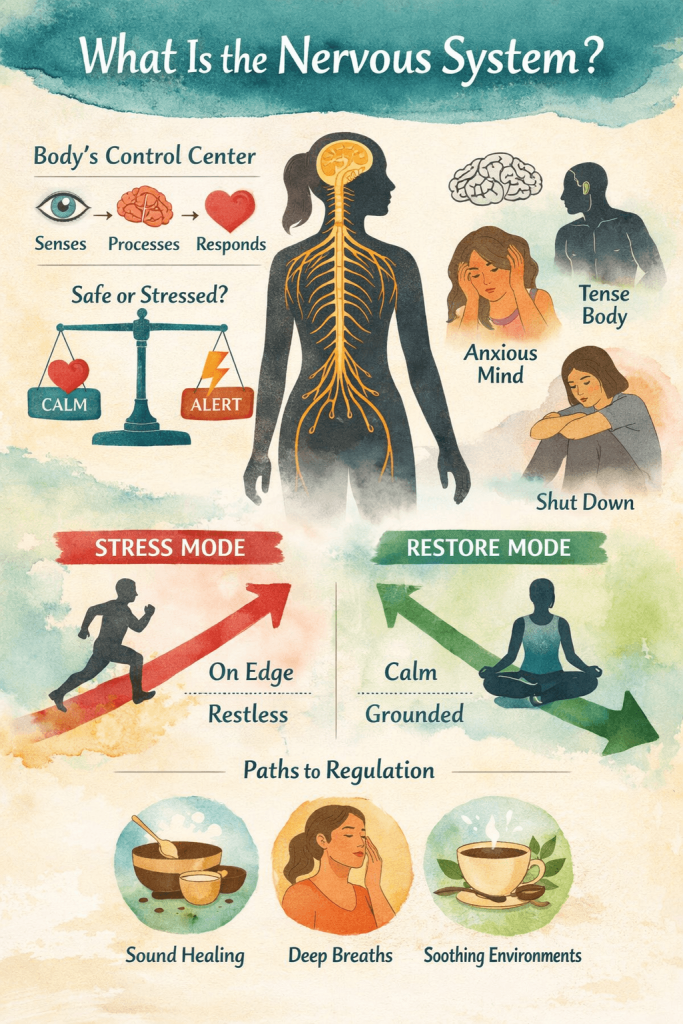
At its simplest, your nervous system is your body’s communication network.
It’s constantly receiving information, processing it, and deciding:
–Am I safe?
–Do I need to act?
–Can I relax?
And it’s doing all of that without you consciously thinking about it.
Your heart rate, your breathing, your muscle tension, your focus, your emotions—
all of it is being shaped moment by moment by your nervous system.
It’s not just reacting to the world.
It’s interpreting it.
The Two Main States You Live In
Without getting overly technical, your nervous system moves between two primary modes:
1. Activation (Survival Mode)
This is when your system senses stress, pressure, or uncertainty.
You might feel:
- Tense
- Alert
- Restless
- Overstimulated
- Unable to settle
This state is designed to help you respond to challenges.
But when it stays on too long… it becomes exhausting.
2. Regulation (Rest & Restore)
This is when your system feels safe enough to soften.
You might feel:
- Calm
- Grounded
- Clear-headed
- Present
- Able to rest
This is where your body repairs, processes, and resets.
The goal isn’t to eliminate activation.
It’s to be able to move between these states fluidly.
What Happens When the Nervous System Gets “Stuck”
This is where things start to feel familiar for a lot of people.
Sometimes the nervous system doesn’t shift back easily.
Even when nothing is actively wrong.
You might notice:
- You’re tired… but can’t fully relax
- Your mind keeps going, even when you want it to stop
- Your body feels tense without a clear reason
- You feel emotionally reactive or overwhelmed
- Or the opposite—you feel flat, disconnected, or shut down
This isn’t a lack of discipline.
It’s your nervous system staying in a pattern it hasn’t yet learned how to leave.
Why This Matters More Than You Think
When your nervous system is dysregulated, it affects:
- How you sleep
- How you think
- How you respond to stress
- How you feel emotionally
- Even how your body processes physical sensations
In other words:
-It shapes your experience of life more than almost anything else.
So… How Do You Know If Something Is “Off”?
It’s often subtle.
But here are a few signs your system may be out of balance:
- You feel “on edge” more often than not
- It’s hard to fully relax, even when you try
- You rely on distraction to feel okay
- Your body feels tight, restless, or fatigued
- You have moments where you feel disconnected from yourself
Or simply:
– You don’t feel like yourself—but you can’t quite explain why
The Important Shift: It’s Not About Fixing—It’s About Supporting
Most people try to think their way out of these states.
Or push through them.
But the nervous system doesn’t respond well to force.
It responds to signals of safety and consistency.
Things like:
- steady rhythm
- gentle repetition
- predictable input
- environments that feel contained and calm
When your body experiences these signals, it begins to shift—
not because you made it… but because it recognized something different.
This Is Where Sound Comes In
Sound is one of the most direct ways to influence the nervous system.
Why?
Because your brain and body are constantly responding to rhythm and frequency.
Slow, consistent sound patterns can:
- encourage the breath to deepen
- reduce muscle tension
- shift brainwave activity toward calmer states
- and signal to the body that it’s safe to come out of alertness
This isn’t just a feeling—it’s measurable.
Your nervous system literally begins to reorganize in response to what it’s experiencing.
A Different Way to Think About It
Instead of asking:
– “What’s wrong with me?”
You can begin asking:
– “What state is my nervous system in right now?”
That one shift changes everything.
Because it moves you from self-judgment…
into understanding.
And from there…
You don’t need to fix yourself.
You just need to give your system
the right conditions to return.
If you’ve been feeling like your body won’t fully settle…
or like you’re carrying more than you can explain…
you’re not alone.
And more importantly—
your system isn’t broken.
It just hasn’t been given the right signals yet.
And the good news is…
it knows how to respond when it finally is.
If your nervous system has been feeling like it won’t fully settle…
this is exactly what Monday Reset is designed for.