

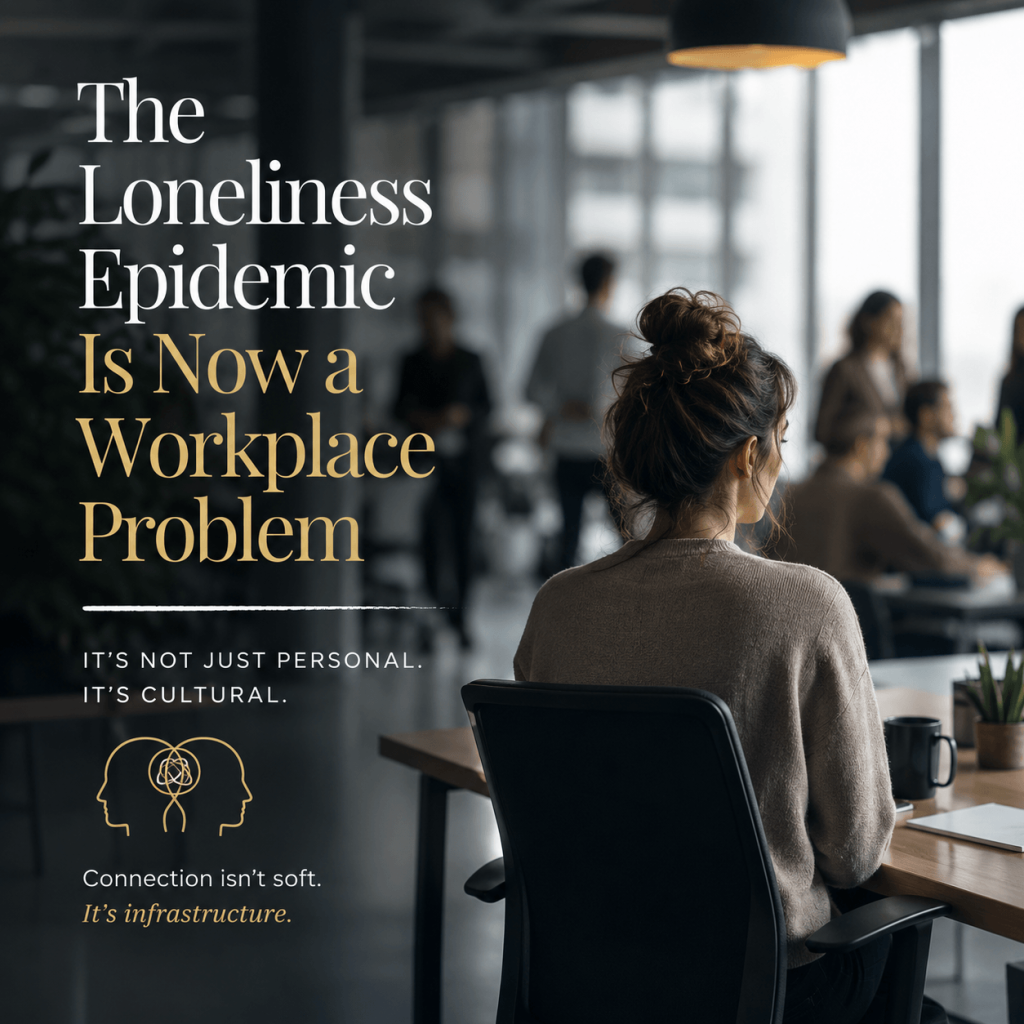
Loneliness is often thought of as something that happens outside of work. We picture someone living alone, lacking close friendships, or feeling isolated after a major life change. But increasingly, loneliness is showing up somewhere many of us spend nearly half our waking hours: the workplace.
You can sit in meetings all day, exchange emails with dozens of people, collaborate on projects, and still leave work feeling profoundly disconnected. In fact, being surrounded by people doesn’t necessarily protect us from loneliness. Sometimes it makes it even harder to recognize.
This isn’t simply about having friends at work. It’s about feeling seen. Valued. Safe enough to contribute. Connected to a purpose beyond checking items off a to-do list.
When those experiences begin to disappear, something changes—not just emotionally, but physiologically.
Our nervous system is wired for connection. Throughout human history, belonging has been tied to survival. When we experience ongoing disconnection, the brain doesn’t simply label it as an unpleasant feeling. It interprets it as a potential threat. Stress hormones rise. Mental energy shifts toward self-protection. Creativity, collaboration, and clear thinking become harder to access.
Over time, that state can quietly become our new normal.
You may notice yourself speaking up less in meetings. You stop sharing ideas. You do your work well enough but feel emotionally checked out. You begin counting down to Friday, not because you dislike your work, but because you’ve stopped feeling connected to it—and perhaps to the people around you.
From the employee’s perspective, this can feel confusing. “Nothing is wrong,” they tell themselves. “I have a good job.”
Yet something feels missing.
Organizations experience the same issue from a different angle. Engagement declines. Collaboration becomes more transactional. Innovation slows. Turnover increases. Leaders may assume the solution is another benefit, another incentive, or another employee appreciation event.
Those things certainly have value. But appreciation and connection are not the same thing.
People rarely thrive simply because they’re recognized once a quarter. They thrive because they consistently experience trust, psychological safety, meaningful relationships, and a sense that they matter.
This is one reason the conversation around workplace wellbeing is evolving.
For years, much of the focus has been on reducing stress and preventing burnout. Those remain important. But many researchers and organizations are beginning to recognize another factor hiding in plain sight: social connection.
Connection isn’t soft.
It’s infrastructure.
It shapes how safely people communicate, how willing they are to ask for help, how effectively teams solve problems, and whether employees can bring their full attention and creativity to their work.
And this isn’t only a workplace issue.
Many people leave the office and continue feeling disconnected at home. Our calendars are full, yet meaningful conversations are often scarce. We stay busy while quietly becoming isolated—from other people, and sometimes even from ourselves.
That may be the deepest cost of loneliness.
It doesn’t simply separate us from others.
It gradually separates us from the parts of ourselves that feel curious, creative, hopeful, and fully alive.
The encouraging news is that connection can be rebuilt.
Often it begins with small moments: a genuine conversation, the courage to be honest about how you’re doing, creating space to slow down, or allowing your nervous system to experience safety long enough to reconnect with yourself.
Because when we reconnect with ourselves, we naturally become more available to connect with others.
Whether you’re an employee, a leader, a business owner, or simply someone navigating a busy life, the question is worth asking:
Where in my life have I mistaken being busy for being connected?
The answer may reveal more than you expect.
Ready to reconnect—with yourself first?
If you’ve been feeling emotionally exhausted, overwhelmed, or simply disconnected from yourself, Monday Reset offers a gentle place to begin.
Each week, I guide a 30-minute live online sound bath and meditation designed to help calm the nervous system, quiet the mental noise, and create the conditions for deeper clarity, resilience, and connection. It’s not about escaping your life—it’s about returning to yourself so you can engage with it more fully.
Sometimes the most important relationship to restore is the one you have with yourself.