If you’ve ever wondered why a sound bath feels so different from pressing play on a meditation app, you’re asking a good question. Both calm you down, but they ask completely different things of your attention, and that difference matters a lot if you’re living with chronic stress. Here’s how the two actually compare, and how to pick the one your nervous system needs right now.
Key takeaways
- A sound bath is a passive experience: you lie down and let instruments like singing bowls, gongs, and chimes do the work, while a guided meditation is active and asks you to follow a voice through breath, attention, or visualization.
- If concentrating feels impossible when you’re overwhelmed, sound tends to land easier because it doesn’t require you to hold your focus.
- Many sessions blend both. At Aurras, our weekly 30-minute Monday Reset pairs a live sound bath with light guidance so you get the ease of sound and the structure of a guided practice.
- Neither is “better” across the board. The right choice depends on how wired or depleted you feel and whether you want to direct your mind or let it rest.
What is a sound bath, and how does it actually work?
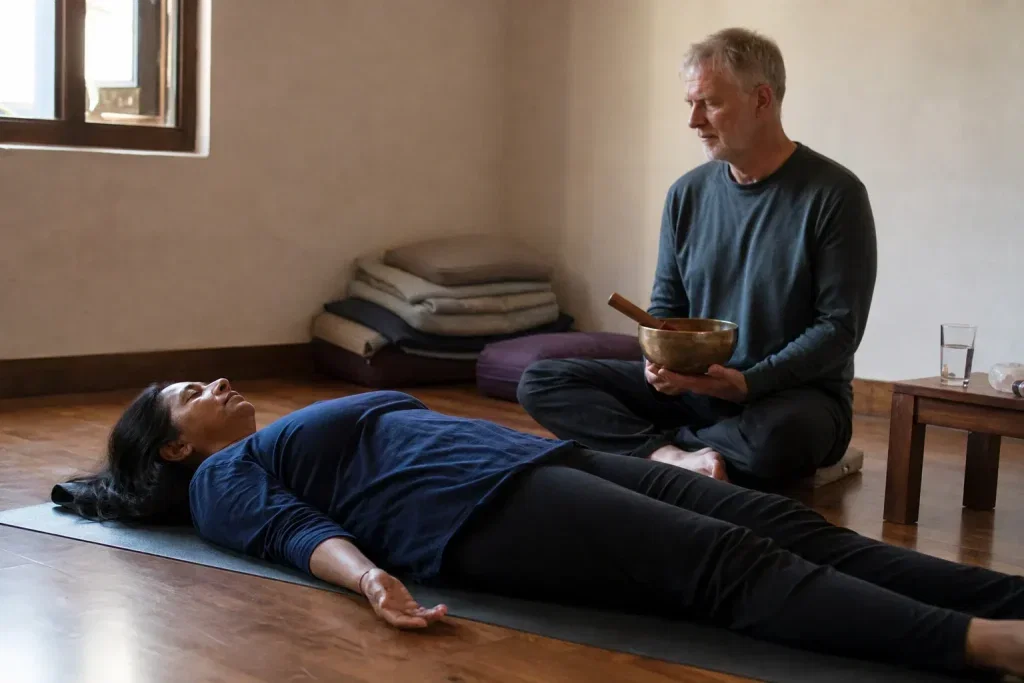
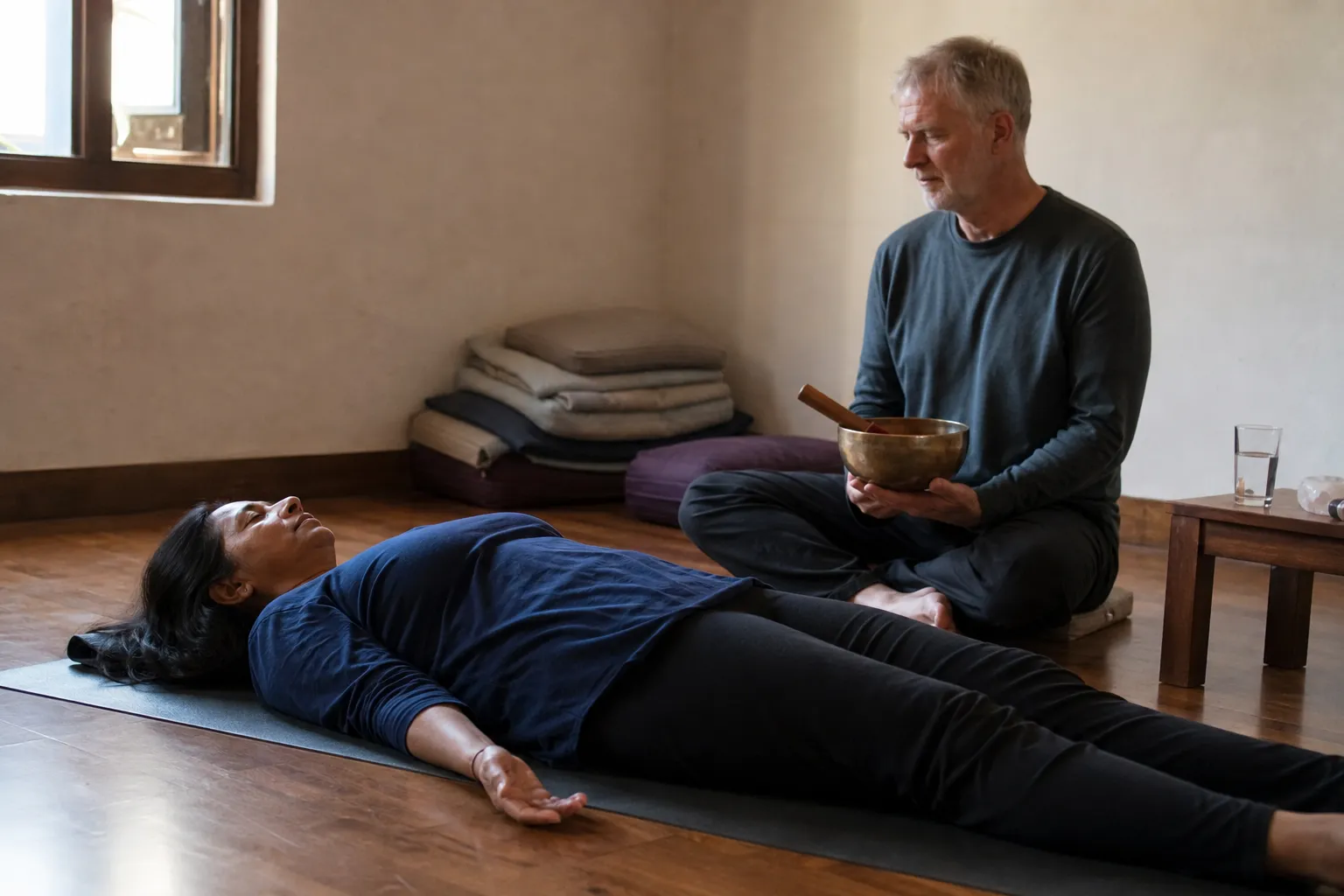
A sound bath is a meditative experience where you lie down, stay still, and let waves of sound from instruments move through you. There’s no pose to hold and no technique to master. Medical News Today describes it as being immersed in sound produced by instruments like singing bowls, gongs, and tuning forks while you rest.
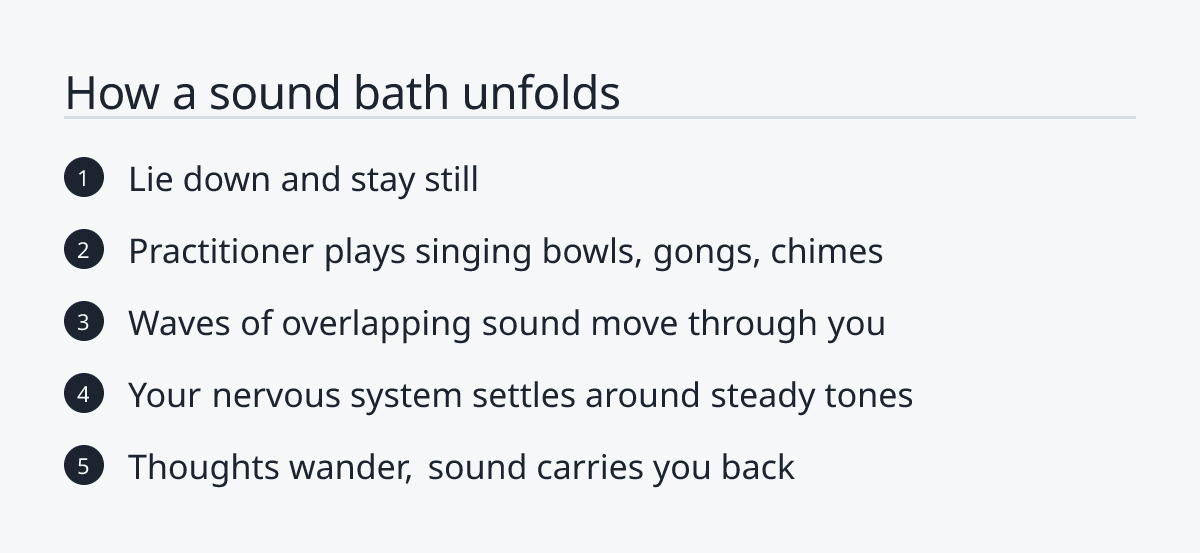
The instruments matter here. In a typical session I’ll work with crystal and metal singing bowls, a gong, chimes, and sometimes the human voice. Each produces steady, overlapping tones that your ear and body register as vibration, not just music. The idea is that these slow, repeating sounds give your nervous system something simple and steady to settle around, the way a quiet, rhythmic sound in a room can make your shoulders drop before you’ve noticed why.
What makes a sound bath distinct is that you’re receiving, not doing. You don’t have to clear your mind or breathe a certain way. If your thoughts wander, the sound keeps going and carries you back without any effort on your part. For people living with chronic stress, that absence of homework is often the whole point, because a stressed mind usually has no spare capacity to concentrate.
If you want a fuller picture of the practice itself, I walk through it in what a sound bath meditation is.
What happens in a regular guided meditation session?
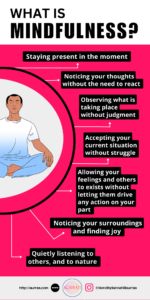
A guided meditation is an active practice where a voice leads you, step by step, through where to put your attention. You might be guided to follow your breath, scan your body part by part, picture a calm scene, or notice thoughts without chasing them. Calm’s guide on the topic describes guided meditation as a practice where a teacher’s voice directs your focus throughout the session.
The work in a guided meditation is yours. The voice gives you instructions, and you do the mental task: return to the breath, soften the jaw, imagine the beach, let the thought float by. That effort is a feature. Training your attention to come back, again and again, is part of how guided meditation builds focus and calm over time.
Because it’s structured, a guided meditation gives you something concrete to practice between sessions. You can do a five-minute body scan before a hard meeting or a breathing meditation when you can’t sleep. It travels well, it’s easy to repeat, and it hands you skills you can use on your own.
The trade-off shows up on your worst days. When you’re truly depleted or your mind is racing, being asked to “gently return your focus to the breath” can feel like one more task you’re failing at. That’s the moment many people seeking deeper rest and meaningful renewal find a guided session frustrating, through no fault of the practice.
What’s the main difference between a sound bath and a guided meditation?
The core difference is effort: a sound bath works on you while you rest, and a guided meditation works through you while you participate. One asks nothing of your focus, the other trains it.
Here’s how the two compare across the things that actually shape your experience:
| Sound bath | Guided meditation | |
|---|---|---|
| What you do | Lie down and receive | Follow spoken instructions |
| Who leads | A practitioner playing instruments | A voice guiding your attention |
| Main tools | Singing bowls, gongs, chimes, voice | Breath, body scan, visualization, words |
| Effort required | Very low | Moderate and ongoing |
| Best when you feel | Overwhelmed, wired, unable to concentrate | Steady enough to focus and want structure |
| What you take home | Deep rest and a reset | Repeatable skills you can practice alone |
| Typical length | 30 to 60 minutes | 5 to 30 minutes |
Notice that neither column is the “advanced” one. They’re built for different states. A sound bath meets you when your tank is empty. A guided meditation serves you when you have a little focus to spend and want to get better at steadying your own mind.
Which is better for chronic stress and nervous system regulation?
For an overwhelmed nervous system, I usually point people toward sound first, and the reason is simple: regulation has to come before training. When you’re in a high-stress state, your body isn’t in a place to learn a focus skill, so asking it to concentrate often adds pressure instead of relief. Sound skips that hurdle because it doesn’t require you to do anything right.
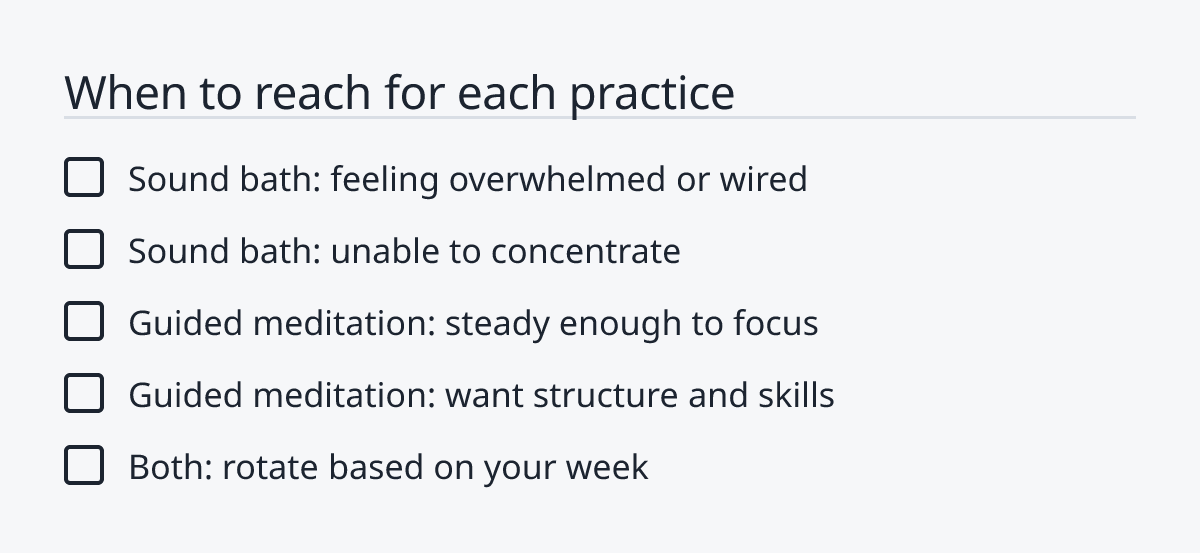
Once your baseline calms down, guided meditation becomes far more useful. With a steadier nervous system, you can actually follow a breathing practice and feel it work, and you start building the ability to calm yourself without a practitioner in the room. Many people seeking nervous system regulation end up wanting both: sound for the hardest weeks, guided practice for maintenance.
Two honest caveats before you choose. Sound baths are a wellness practice, not a medical treatment, and the research on them is still early and small. Ringconn’s review of the evidence on sound baths notes that studies so far are limited and that the practice shouldn’t replace care for a diagnosed condition. If you have a seizure disorder, use a cochlear implant or pacemaker, or are sensitive to loud or sustained sound, check with your doctor before trying one, and tell your practitioner so they can adjust.
Can you combine a sound bath and a guided meditation?
Yes, and blending them is one of the most practical ways to get the benefits of each. A combined session usually opens with a short spoken guide to settle you and set an intention, then moves into sound so you can let go of effort and simply rest. You get the gentle structure of guidance without being asked to concentrate for the full session.
That blend is exactly how I built the Aurras Monday Reset. It’s a 30-minute live session every Monday that pairs a sound bath with light guided meditation, designed to calm an overwhelmed nervous system and give you a clean start to the week. The single drop-in session is $9, and full-month access runs $27 a month, so you can try one Monday before committing to a stretch. Most people find attending regularly each week both reduces the build up of stress and helps to maintain a calmer nervous system.
If you’d rather test the water on your own first, I keep a set of free sound bath videos you can lie down with tonight. And if you want to understand what you’re choosing between before you book anything, the sections above should give you a clear read on which direction fits the week you’re having.
I’ve been guiding this work since 2018, and I hold certifications through the Vibrational Sound Association, Heaven of Sound, and with Dr Rainer Michalis, so when you lie down in a session you’re resting in practiced hands. If you’re not sure which practice suits you, send me a note through the contact page and I’ll point you to a starting place within 24 hours or less.
Frequently asked questions
Is a sound bath a type of meditation?
A sound bath is a form of meditation, but a passive one. Instead of guiding your attention with instructions, it uses sustained sound from instruments like singing bowls and gongs to help your mind settle on its own. You reach a meditative state by receiving the sound rather than by directing your focus.
Do I need meditation experience to try a sound bath?
No. A sound bath is one of the easiest practices to start with because there’s nothing to learn and no technique to get right. You lie down, close your eyes, and let the sound carry you, which is why people who find traditional guided meditation hard to focus on often take to sound baths quickly.
Which is better for people living with chronic stress, a sound bath or a guided meditation?
For acute, overwhelmed stress, a sound bath is usually the gentler entry point because it asks nothing of your concentration while your nervous system settles. Once you feel steadier, guided meditation adds value by teaching you skills you can use on your own. Many people living with chronic stress use both: sound to reset and guided practice to maintain.
How long does a sound bath last compared to a guided meditation?
Sound baths typically run 30 to 60 minutes, since the deep rest they produce takes time to settle into. Guided meditations are often shorter, anywhere from 5 to 30 minutes, because they’re built to be repeated through the day. The Aurras Monday Reset keeps its blended session to 30 minutes so it fits into a busy Monday.
Are sound baths backed by scientific evidence?
The research is still early and small. Ringconn’s review of the evidence notes that studies on sound baths are limited, so the practice is best treated as a tool for rest and relaxation rather than a medical treatment. If you have a specific health condition, keep it alongside your regular care and check with your doctor first.