

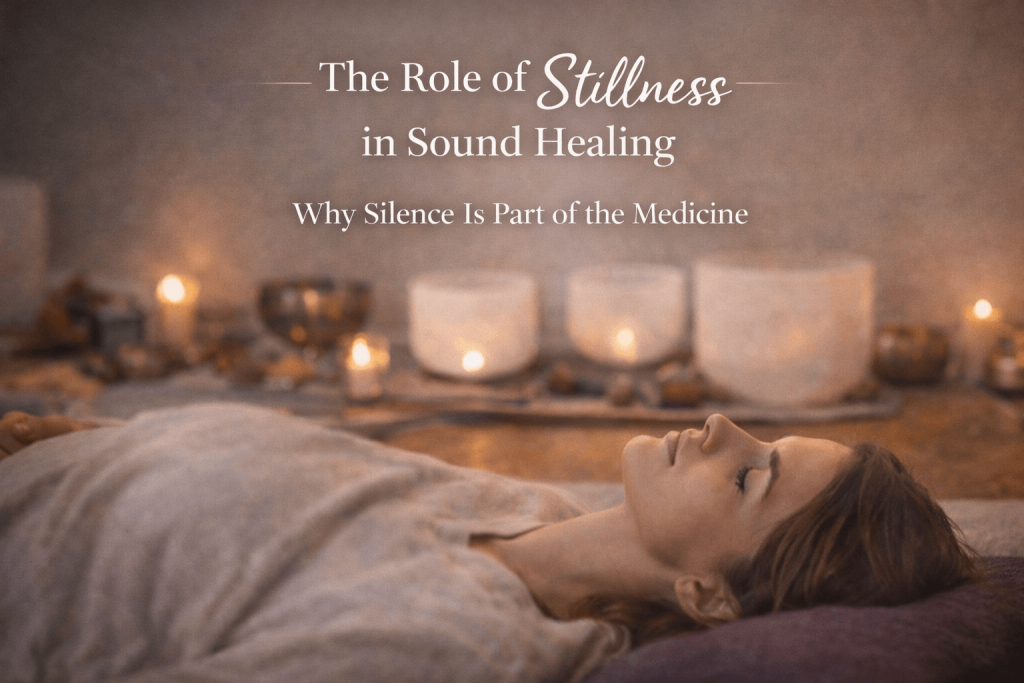
Why Silence Is Part of the Medicine
When people think of sound healing, they think of the sound.
The tones.
The resonance.
The way vibration seems to move through the body and shift something almost immediately.
But there’s another part of the experience that is just as important—
and often overlooked.
The stillness.
The moments where nothing is happening.
No tone. No guidance. No movement.
Just… space.
And for many people, that’s the part that feels the most unfamiliar.
Stillness Can Feel Like “Nothing”
In a world that is constantly filled—with noise, information, stimulation—stillness can feel like an absence.
Like something is missing.
The mind may start to wander, search, or even resist:
Should something be happening right now?
Am I doing this right?
Why is it so quiet?
But that quiet isn’t empty.
It’s intentional.
Sound Opens the Door. Stillness Lets It Land.
Sound initiates the shift.
It draws your attention inward.
It interrupts the constant loop of thought.
It begins to soften the nervous system.
But it’s the stillness that allows that shift to integrate.
Without pauses, the experience becomes continuous input—something the brain continues to process and track.
With stillness, something different happens:
The system begins to settle into what was just experienced.
The body has time to respond.
To reorganize.
To soften further without being guided or stimulated.
It’s in that space that the work deepens.
The Nervous System Needs Space, Not Just Input
We often think more input equals more benefit.
But the nervous system doesn’t work that way.
It doesn’t just need stimulation—it needs space to process.
Moments of stillness allow the system to:
- come out of constant engagement
- shift from doing to receiving
- register safety without needing to respond
This is where regulation becomes more stable.
Not because something is happening,
but because nothing is required.
Stillness Is Where the Body Speaks
When sound fades, something else becomes more noticeable.
The breath.
Subtle sensations.
The internal landscape that’s usually covered by noise and distraction.
This is where the body begins to communicate in a different way.
Not through language.
Not through insight.
But through sensation.
A softening in the chest.
A heaviness in the limbs.
A sense of settling that doesn’t need to be named.
Stillness makes space for that awareness to emerge.
The Discomfort of Doing Nothing
For many people, stillness is the hardest part.
Not because it’s difficult…
but because it removes structure.
There’s nothing to follow.
Nothing to focus on.
Nothing to achieve.
And that can feel unsettling.
But that discomfort is often a sign of how rarely the system is given permission to simply be.
Over time, what first feels unfamiliar can begin to feel supportive.
Even restorative.
Silence Isn’t Empty. It’s Active in a Different Way.
Silence in a sound bath isn’t a gap or a pause for the sake of pacing.
It’s part of the experience itself.
It’s where the nervous system shifts from input to integration.
Where the body moves from guided to self-organizing.
Where something internal has space to unfold naturally.
It may not feel dramatic.
But it is significant.
You Don’t Have to Fill the Space
When the sound fades and stillness takes over, there’s nothing you need to do.
No need to focus harder.
No need to create an experience.
You can simply remain.
Because sometimes the most meaningful part of the session isn’t what you hear…
It’s what happens when there’s nothing left to listen to.
And That’s Where the Medicine Is
Not only in the sound.
But in the space it leaves behind.
In the quiet that follows.
In the moment where your system realizes—
it doesn’t have to do anything at all.
And in that realization, something begins to settle.
Not because it was guided.
But because it was finally given the space to.
If your mind doesn’t slow down easily…
this is where your system learns how.