


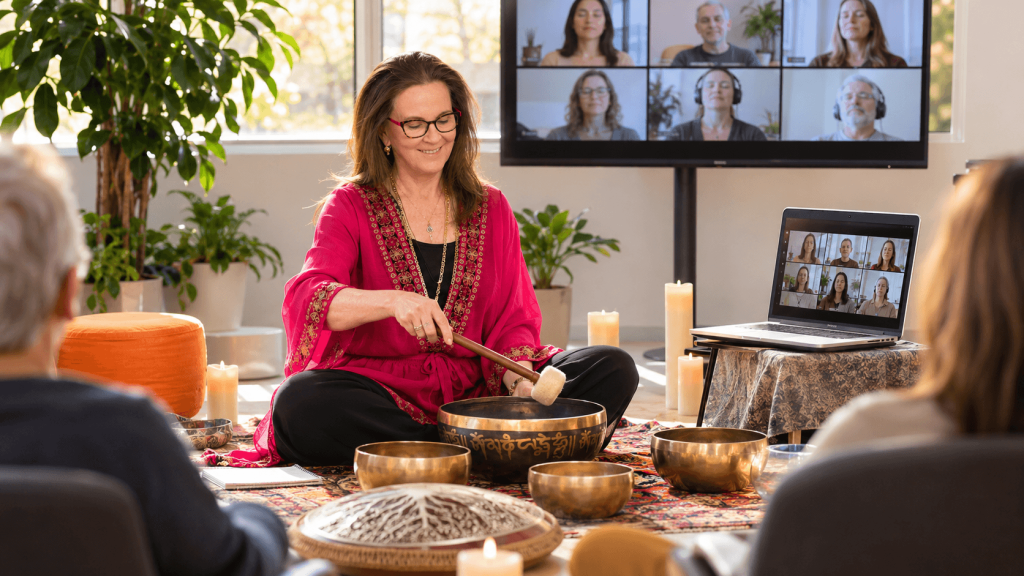
Moving beyond traditional workplace wellness to experiences that support the nervous system, encourage stress recovery, and help employees feel genuinely cared for.
Key Takeaways
- Corporate wellness is evolving. Forward-thinking employers are moving beyond traditional wellness benefits toward experiences that help employees manage stress, recover, and feel supported.
- Nervous system regulation supports stress recovery and focus. When the nervous system shifts away from heightened alertness toward a more regulated state, the body is better positioned to recover from stress, supporting the attention and mental clarity employees need.
- Sound therapy creates an opportunity for that shift. The resonant tones of Tibetan singing bowls, combined with guided meditation and intentional rest, help create conditions for relaxation, reduced tension, and recovery.
- Research supports the benefits of sound-based relaxation. Studies have documented improvements in tension, mood, and stress-related outcomes following sound meditation and music-based interventions.
- Sound baths are accessible and adaptable. Corporate sound therapy can be incorporated into employee appreciation events, wellness days, team gatherings, leadership retreats, and virtual wellness programs without requiring previous meditation experience.
Beyond Traditional Corporate Wellness
Corporate wellness has come a long way. Employers increasingly recognize that supporting employee well-being isn’t simply a nice benefit. It’s part of creating a workplace where people can thrive.
Yet there’s a question worth asking:
Are we helping employees learn about managing stress, or are we giving them opportunities to actually experience relief from it?
There’s an important difference.
An employee can attend a workshop about resilience, understand the importance of mindfulness, and know perfectly well that stress affects their health. But knowing what to do doesn’t necessarily mean their body knows how to settle after a demanding day.
That’s where sound therapy offers a different approach to corporate wellness.
Rather than asking employees to think harder about their well-being, a sound bath invites them to experience something: a period of stillness, soothing sound, and relief from the constant demands on their attention.
And when the nervous system has an opportunity to settle, employees can recover from stress and return to their responsibilities with a greater sense of calm and mental clarity.
For employees who spend their days making decisions, solving problems, and responding to everyone else’s needs, that experience can be surprisingly meaningful.
Why Traditional Corporate Wellness Doesn’t Always Reach the Problem
Many workplace wellness programs focus on teaching employees how to take better care of themselves.
There are seminars on stress management, workshops on resilience, fitness challenges, meditation apps, and educational programs about mental health.
These can all have value.
But consider the employee who has spent the morning navigating a difficult client conversation, managing competing deadlines, and responding to a steady stream of messages.
By lunchtime, their shoulders may be tight, their breathing shallow, and their mind still racing through everything that needs attention.
They probably don’t need someone to explain that stress is unhealthy.
They already know.
What they need is an opportunity to experience what happens when the demands temporarily stop.
The next evolution in corporate wellness isn’t necessarily more information. It’s creating experiences that help people move from understanding stress to recognizing what relief actually feels like.
Sound therapy complements an organization’s existing wellness efforts by offering precisely that kind of experience.
The Neuroscience of Stress, Recovery, and Mental Focus
Stress isn’t simply a feeling. It’s a coordinated physiological response involving the brain, nervous system, hormones, and body.
When the brain perceives a challenge or threat, the sympathetic nervous system helps prepare us to respond. Heart rate increases, muscles tighten, and attention narrows toward whatever requires immediate action.
This response is essential. It helps us meet deadlines, navigate emergencies, and perform under pressure.
The difficulty arises when demands remain high and opportunities for recovery remain limited.
An employee may finish a difficult meeting, but their nervous system doesn’t necessarily recognize that the pressure has ended. Their mind moves to the next responsibility, and the body continues carrying tension from the last one.
Over time, insufficient recovery contributes to fatigue, irritability, difficulty concentrating, and disrupted sleep.
Why Nervous System Regulation Matters
The autonomic nervous system continually adjusts our physiological state in response to changing demands.
Its sympathetic branch helps mobilize us for action, while parasympathetic processes contribute to recovery, restoration, and the return toward a more settled state.
A healthy nervous system isn’t one that remains relaxed all the time. It’s one that responds appropriately to challenges and recovers when those challenges have passed.
That ability to shift between activation and recovery is an important part of nervous system regulation.
When stress responses remain elevated, attention becomes increasingly occupied with perceived demands or threats. Working memory, cognitive flexibility, and concentration can suffer.
Research into the brain’s prefrontal cortex demonstrates how stress interferes with the neural systems responsible for attention, working memory, and higher-order thinking. Neuroscientist Amy Arnsten describes these mechanisms in Stress Signalling Pathways That Impair Prefrontal Cortex Structure and Function.
When the body has an opportunity to recover, those cognitive demands can ease.
This is the important connection for corporate wellness: supporting recovery from stress also supports the conditions employees need for clearer thinking, better concentration, and more flexible responses to everyday challenges.
Recovery deserves a place alongside performance in the way organizations think about employee well-being.
How Sound Therapy Supports Relaxation
Sound therapy offers a sensory experience that encourages a shift away from constant problem-solving and toward more relaxed attention.
During a sound bath, participants listen to the layered tones and resonances of Tibetan singing bowls.
The sounds rise, overlap, change, and gradually fade.
Rather than following a conversation, solving a problem, or making another decision, participants can simply listen.
This change in attentional demands, combined with guided meditation and a comfortable environment, creates an opportunity for relaxation and reduced tension.
Research published in the Journal of Evidence-Based Complementary & Alternative Medicine examined 62 participants who experienced singing bowl sound meditation. Participants reported significant reductions in tension, anger, fatigue, and depressed mood immediately afterward.
You can read the study, Effects of Singing Bowl Sound Meditation on Mood, Tension, and Well-being, here.
The broader evidence is encouraging as well. A systematic review and meta-analysis of 104 randomized controlled trials involving 9,617 participants found that music-based interventions significantly reduced psychological and physiological stress-related outcomes.
That research is available in Effects of Music Interventions on Stress-Related Outcomes.
While these studies do not establish that every sound bath produces the same results or directly improves workplace productivity, they provide a meaningful scientific foundation for considering sound-based experiences as part of employee wellness.
And sometimes the opportunity to pause is exactly what has been missing from the workday.
Sound Therapy: An Experience Rather Than Another Wellness Assignment
Most employees spend a considerable portion of their day processing information.
They read, listen, analyze, decide, respond, and communicate.
Even a well-intentioned wellness workshop can become another activity requiring concentration and participation.
A sound bath changes that dynamic.
Participants are invited to sit or lie comfortably while a facilitator offers a brief introduction, gentle guidance, and live sound.
There are no worksheets to complete, lessons to remember, or exercises to get right.
For some participants, the experience brings deep relaxation. Others notice that their thoughts slow down, their muscles soften, or they feel more emotionally settled.
Some simply appreciate having uninterrupted time when nothing is being asked of them.
Sometimes the most meaningful thing an employer can offer isn’t another strategy for doing more. It’s an opportunity to stop doing for a little while.
That distinction makes sound therapy a valuable addition to the conversation about modern corporate wellness.
Why Corporate Sound Therapy Makes Sense for HR Leaders
For human resources professionals, workplace wellness isn’t simply about finding an interesting activity.
It’s about supporting people while balancing practical considerations: employee engagement, accessibility, budgets, scheduling, organizational culture, and the overall employee experience.
Sound therapy offers several advantages worth considering.
1. Supporting Stress Recovery and Mental Clarity
Employees who move continuously from one demand to another have limited opportunities for genuine recovery during the workday.
A sound bath creates a defined period when the usual demands on attention are reduced.
Participants have an opportunity to leave feeling calmer, less tense, and better able to concentrate.
Recovery is an essential part of sustaining effective performance, and a corporate sound bath provides a structured opportunity to experience it.
2. Making Employee Appreciation Something People Can Feel
Employees often hear that their well-being matters.
An intentional experience devoted entirely to their comfort and restoration offers a different way to communicate that message.
It says, in effect, Your well-being deserves time and attention, not just another reminder to take care of yourself.
That can be particularly meaningful in environments where employees are accustomed to giving their time, energy, and attention to others.
A sound bath doesn’t replace reasonable workloads, supportive leadership, or healthy workplace policies.
But it can be a thoughtful expression of an organization’s commitment to its people.
3. Offering an Accessible Wellness Experience
Employees don’t need to understand meditation, practice yoga, or consider themselves particularly interested in wellness.
A well-facilitated sound bath offers a straightforward invitation: get comfortable, listen, and allow yourself to rest.
Participation should be voluntary, with comfortable seating, accommodations for individual needs, and the option to step away.
The goal is not to make every employee respond in the same way. It’s to create a welcoming opportunity that many different people can enjoy.
4. Bringing Something Different to Corporate Events
Sound therapy fits a variety of workplace experiences, including:
- Employee wellness and appreciation days
- Leadership retreats and team offsites
- Staff development and recognition events
- Healthcare and other high-demand professional settings
- Live virtual wellness experiences for remote or hybrid teams
The experience can be adapted to different group sizes, event schedules, and organizational objectives.
For HR professionals seeking something more memorable than another presentation, sound therapy offers a distinctive alternative.
5. Creating Space for Human Connection
Workplaces bring together people who may spend considerable time interacting professionally without having many opportunities to simply share a quiet experience.
A group sound bath creates a moment of collective pause.
Participants aren’t required to talk about their feelings, disclose personal information, or participate in traditional team-building exercises.
They’re simply sharing an experience.
That can create a sense of connection without demanding social performance.
And for employees who spend much of their day responding to others, the absence of expectations may be part of what makes the experience restorative.
What Happens During a Corporate Sound Bath?
For employees who have never attended a sound bath, the name itself can create curiosity.
Despite the word bath, there is no water involved.
A sound bath is an immersive listening experience using resonant instruments such as Tibetan singing bowls.
At Aurras Sound Therapy, the experience begins with a brief introduction that helps participants understand what to expect and how sound and focused listening support relaxation.
Participants are invited to settle into a comfortable position, either seated or lying down, depending on the setting.
A short guided meditation helps direct attention away from the demands of the day and toward the present moment.
Then the sounds of the Tibetan singing bowls become the central experience.
The tones unfold gradually, creating an atmosphere in which participants can rest without having to follow instructions or actively manage their thoughts.
The session concludes with a gentle transition back to ordinary awareness.
There’s no pressure to share personal experiences afterward.
Employees can simply notice how they feel and return to their day.
For many first-time participants, one of the most welcome aspects is discovering that they don’t have to do anything to participate successfully.
Measuring the Value of Corporate Sound Therapy
HR leaders understandably want to know whether wellness investments make a difference.
Participation rates, employee feedback, and program satisfaction are useful measures.
But not every benefit can be captured through an immediate productivity calculation.
Consider the employee who leaves a sound bath feeling less tense, more settled, or simply grateful that their employer made room for the experience.
That moment may not translate neatly into a spreadsheet.
It can still matter.
Organizations can gather voluntary, anonymous feedback about the experience, including whether participants:
- Felt more relaxed or less tense afterward
- Experienced greater mental clarity
- Found the experience accessible and comfortable
- Appreciated having dedicated time for recovery
- Would welcome similar opportunities in the future
These responses provide useful information about employees’ experiences and the perceived value of the program.
Sound therapy works best as one component of a thoughtful corporate wellness strategy, alongside healthy organizational practices and supportive leadership.
Its value lies in creating an experience that supports well-being while reinforcing a culture that recognizes employees as people, not simply as performers.
Meet Dorothy Tannahill-Moran, Founder of Aurras Sound Therapy
Dorothy Tannahill-Moran has been facilitating sound therapy experiences since 2018, bringing together the resonant qualities of Tibetan singing bowls, guided meditation, and a neuroscience-informed understanding of stress and the nervous system.
She holds two sound therapy certifications, including training through the Vibrational Sound Association and Heaven of Sound, and is also a certified life coach.
Over a recent 12-month period, Dorothy facilitated 142 sound baths representing approximately 3,000 participant experiences.
Her approach combines professional training with an understanding of how difficult it can be for people to step away from the constant demands of everyday life.
Through Aurras Sound Therapy, she creates accessible, restorative experiences for individuals, groups, businesses, and community organizations.
Based in the Greater Kansas City area, Aurras offers in-person corporate sound baths as well as live virtual experiences for organizations with geographically dispersed teams.
Frequently Asked Questions About Corporate Sound Therapy
What is sound therapy in a corporate wellness setting?
Corporate sound therapy is a facilitated listening and relaxation experience using resonant instruments, such as Tibetan singing bowls, often combined with guided meditation.
It offers employees an opportunity to step away from workplace demands and experience a period of intentional rest.
Can sound therapy help employees recover from stress and improve focus?
Sound therapy supports relaxation and reduced tension, creating an opportunity for recovery from stress.
Stress recovery supports the cognitive conditions needed for concentration and clearer thinking. Employees often value the opportunity to return to their responsibilities feeling calmer and mentally refreshed.
Individual experiences vary, and direct effects on workplace productivity have not yet been established.
Is there scientific evidence supporting sound baths?
Yes. Research on singing bowl meditation has documented improvements in self-reported tension and mood immediately following sessions.
Broader studies of music-based interventions have also demonstrated reductions in psychological and physiological stress-related outcomes.
These findings support the use of sound-based relaxation as a complementary wellness experience, while research continues into the specific mechanisms and longer-term effects of singing bowl therapy.
Do employees need previous meditation experience?
No. Participants are guided through the experience and don’t need any previous meditation or sound therapy experience.
They can simply listen and rest.
How long does a corporate sound bath last?
Corporate sound bath experiences can be adapted to different event formats, commonly ranging from approximately 45 to 90 minutes.
The appropriate duration depends on the organization’s schedule, group size, and objectives.
Can sound therapy work for employees who aren’t interested in traditional wellness activities?
Yes. Some employees find a sound bath appealing because it doesn’t require physical exercise, discussion, or learning a new technique.
Participation is voluntary, and individual comfort and preferences are respected.
Can corporate sound baths be offered virtually for remote or hybrid employees?
Absolutely. Live virtual sound baths allow employees to participate from home, satellite offices, or different geographic locations.
Employees connect through an online meeting platform and listen to the live experience using their computer, headphones, or speakers.
A virtual sound bath includes the same essential elements as an in-person experience: a brief introduction, guided meditation, and live Tibetan singing bowls.
For HR leaders managing remote or hybrid teams, this creates an opportunity to offer a shared wellness experience without requiring travel or bringing everyone into the same physical space.
It can also be incorporated into virtual employee appreciation events, company-wide wellness initiatives, or recurring programs.
What does a corporate sound bath cost?
Corporate sound bath pricing depends on several factors, including the number of participants, session duration, location, and whether the experience is delivered in person or virtually.
Aurras offers group pricing for corporate events, with options tailored to the organization’s needs and budget.
For an accurate quote, HR professionals and event organizers can share their anticipated group size, preferred date, location, and type of event.
The goal is to create an experience that provides meaningful value for employees while fitting the organization’s event objectives.
Is sound therapy appropriate for healthcare workers and other high-stress professions?
Sound therapy offers a welcome opportunity for rest in high-demand environments, including healthcare.
Sessions are designed as optional wellness experiences, with consideration for sensory sensitivities, accessibility, and individual needs.
Sound therapy complements, rather than replaces, appropriate staffing, workload management, and professional mental health support.
How can HR determine whether employees value the experience?
HR teams can gather anonymous feedback about perceived relaxation, mental clarity, accessibility, and overall satisfaction.
They can also evaluate participation and employee interest in future sessions.
These measures help organizations understand the experience’s value and determine how sound therapy fits into their broader wellness strategy.
The Future of Corporate Wellness Is Something Employees Can Experience
Corporate wellness doesn’t need to abandon education, fitness, or traditional employee benefits.
Those resources remain important.
But there is room for something more experiential—something that helps employees recognize the difference between carrying stress and having an opportunity to recover from it.
Sound therapy offers one way to create that experience.
It asks very little of participants while giving them something that can be difficult to find during a busy workday: a genuine pause.
And that pause gives employees an opportunity to return to their responsibilities feeling calmer, more focused, and better able to respond to what comes next.
Perhaps that’s part of what makes this approach feel new.
Instead of simply encouraging employees to manage stress better, organizations can create moments when employees are invited to put their responsibilities down.
Even briefly.
Because employees don’t just need to know that their well-being matters. Sometimes they need to feel it.
Bring Sound Therapy to Your Workplace
Aurras Sound Therapy partners with organizations throughout Greater Kansas City and offers live virtual experiences for remote and hybrid teams.
Whether you’re planning an employee appreciation event, wellness day, team offsite, or leadership retreat, Dorothy can help you create a restorative experience tailored to your group.
Explore corporate sound therapy with Aurras: Corporate Wellness & Sound Baths
Update this link when the dedicated corporate wellness page goes live.
Research and Further Reading
Goldsby, T. L., Goldsby, M. E., McWalters, M., & Mills, P. J. (2017). Effects of Singing Bowl Sound Meditation on Mood, Tension, and Well-being: An Observational Study. Journal of Evidence-Based Complementary & Alternative Medicine, 22(3), 401–406. https://doi.org/10.1177/2156587216668109
de Witte, M., et al. (2020). Effects of Music Interventions on Stress-Related Outcomes: A Systematic Review and Two Meta-Analyses. Health Psychology Review, 14(2), 294–324. https://doi.org/10.1080/17437199.2019.1627897
Arnsten, A. F. T. (2009). Stress Signalling Pathways That Impair Prefrontal Cortex Structure and Function. Nature Reviews Neuroscience, 10, 410–422. https://doi.org/10.1038/nrn2648