

If you’ve wondered why a sound bath feels so different from pressing play on a meditation app, you’re asking the right question before you book. At Aurras™, I offer both sound therapy and guided meditation to help you regulate stress and settle an overwhelmed nervous system, and the two work in opposite directions. The main difference is effort: a sound bath is passive, so you lie down and receive sound, while a guided meditation is active and asks you to follow spoken instructions.
Key takeaways
- A sound bath is a passive experience. You lie down and let instruments like singing bowls, gongs, and chimes do the work.
- A guided meditation is active. A voice leads you through breath, attention, or visualization, and the mental work is yours.
- If concentrating feels impossible when you’re overwhelmed, sound tends to land easier because it never asks you to hold your focus.
- Many sessions blend both. My weekly 30-minute Monday Reset pairs a live sound bath with light guidance.
- Neither is “better” across the board. The right one depends on how wired or depleted you feel this week.
What’s the main difference between a sound bath and a guided meditation?
The core difference is effort: a sound bath works on you while you rest, and a guided meditation works through you while you participate. One asks nothing of your focus, the other trains it. Here is how they compare across the things that actually shape your experience:
| Sound bath | Guided meditation | |
|---|---|---|
| What you do | Lie down and receive | Follow spoken instructions |
| Who leads | A practitioner playing instruments | A voice guiding your attention |
| Main tools | Singing bowls, gongs, chimes, voice | Breath, body scan, visualization, words |
| Effort required | Very low | Moderate and ongoing |
| Best when you feel | Overwhelmed, wired, unable to concentrate | Steady enough to focus and want structure |
| What you take home | Deep rest and a reset | Repeatable skills you can practice alone |
| Typical length | 30 to 60 minutes | 5 to 30 minutes |
Neither column is the “advanced” one. A sound bath meets you when your tank is empty. A guided meditation serves you when you have a little focus to spend and want to get better at steadying your own mind.
What is a sound bath, and how does it actually work?
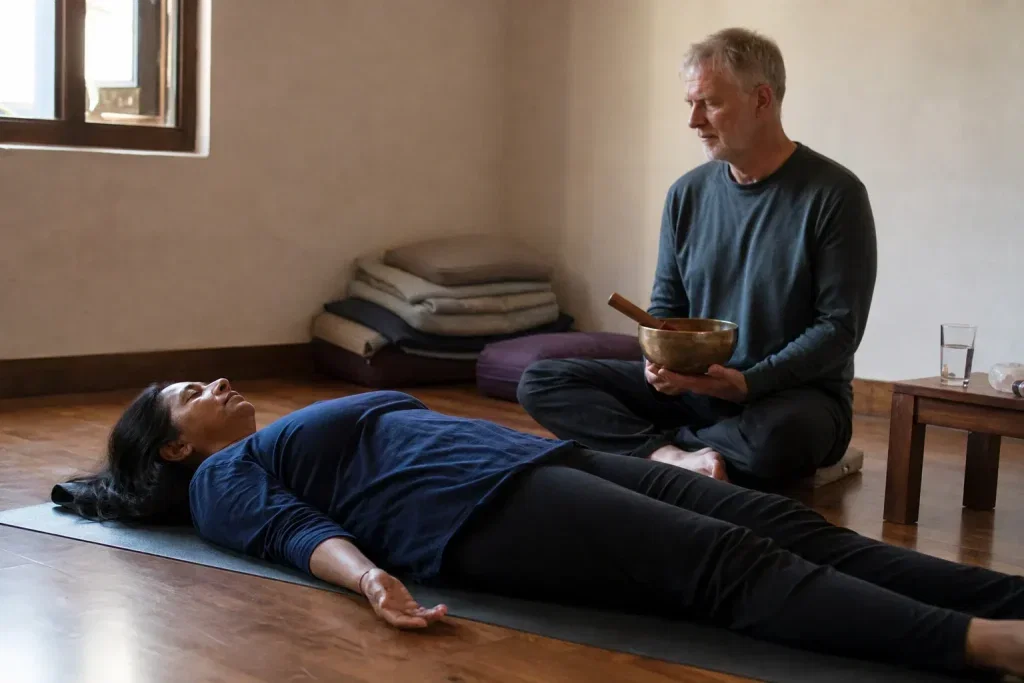
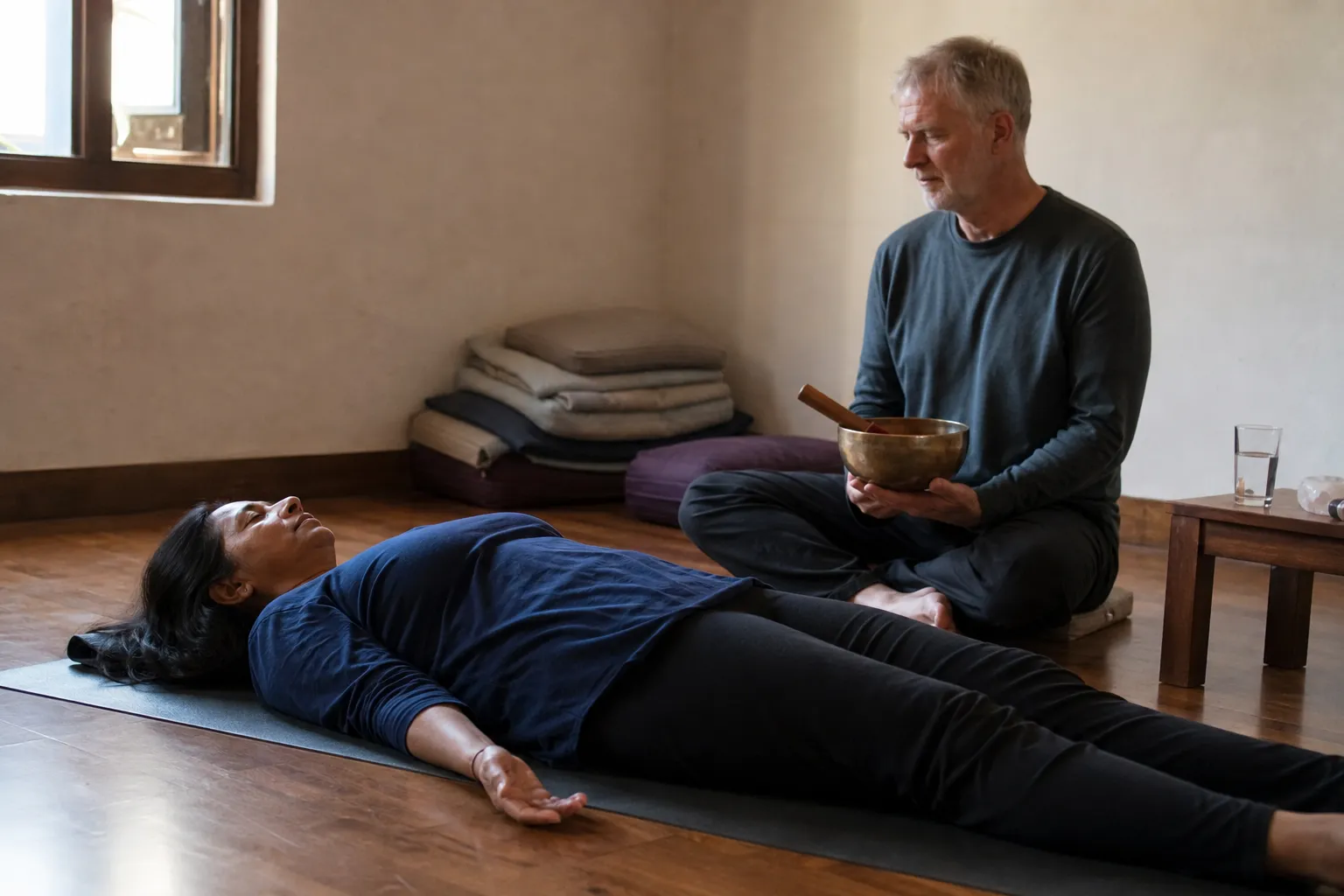
A sound bath is a meditative experience where you lie down, stay still, and let waves of sound move through you. There’s no pose to hold and no technique to master. Medical News Today describes it as being immersed in sound produced by instruments like singing bowls, gongs, and tuning forks while you rest (medicalnewstoday.com).
The instruments matter. In a session I’ll work with crystal and metal singing bowls, a gong, chimes, and sometimes the human voice. Each produces steady, overlapping tones your body registers as vibration, not just music. Those slow, repeating sounds give your nervous system something simple to settle around, the way a quiet, rhythmic sound in a room makes your shoulders drop before you notice why.
What makes a sound bath distinct is that you’re receiving, not doing. If your thoughts wander, the sound keeps going and carries you back with no effort on your part. For people living with chronic stress, that absence of homework is often the whole point, because a stressed mind usually has no spare capacity to concentrate. One person who came to a session told me she slept 7.5 hours that night, a record for her.
What happens in a regular guided meditation session?
A guided meditation is an active practice where a voice leads you, step by step, through where to put your attention. You might follow your breath, scan your body part by part, picture a calm scene, or notice thoughts without chasing them. The work is yours, and that effort is a feature. Training your attention to come back, again and again, is part of how guided meditation builds calm over time.
Because it’s structured, a guided meditation hands you something concrete to practice on your own. You can do a five-minute body scan before a hard meeting or a breathing meditation when you can’t sleep. It travels well and gives you skills you keep.
The trade-off shows up on your worst days. When you’re truly depleted or your mind is racing, being asked to “gently return your focus to the breath” can feel like one more task you’re failing at. That’s the moment many people seeking deeper rest and meaningful renewal find a guided session frustrating, through no fault of the practice.
Which is better for chronic stress and nervous system regulation?
For an overwhelmed nervous system, I usually point people toward sound first, because regulation has to come before training. When you’re in a high-stress state, your body isn’t in a place to learn a focus skill, so asking it to concentrate adds pressure instead of relief. Sound skips that hurdle because it doesn’t require you to do anything right.
Once your baseline calms down, guided meditation becomes far more useful. With a steadier nervous system you can actually follow a breathing practice and feel it work, and you start building the ability to calm yourself without a practitioner in the room. Many people seeking nervous system regulation end up wanting both: sound for the hardest weeks, guided practice for maintenance.
Two honest caveats. Sound baths are a wellness practice, not a medical treatment, and the research is still early and small. Ringconn’s review of the evidence notes that studies so far are limited and that the practice shouldn’t replace care for a diagnosed condition (ringconn.com). If you have a seizure disorder, use a cochlear implant or pacemaker, or are sensitive to sustained sound, check with your doctor first and tell me so I can adjust.
Can you combine a sound bath and a guided meditation?
Yes, and blending them is one of the most practical ways to get the benefits of each. A combined session opens with a short spoken guide to settle you and set an intention, then moves into sound so you can let go of effort and rest. You get the gentle structure of guidance without being asked to concentrate the whole way through.
That blend is exactly how I built the Monday Reset. It’s a 30-minute live session every Monday at 10:00 AM Central that pairs a sound bath with light guided meditation, designed to calm an overwhelmed nervous system and give you a clean start to the week. A single drop-in session is $9, and full-month access is $27 a month, so you can try one Monday before committing. If you’d rather be in the room, in-person sound baths are $35.
Where does Aurras™ serve, and how do you book?
Aurras™ serves Overland Park, Kansas and the Greater Kansas City metro for in-person sound baths, and the Monday Reset streams live online so you can join from anywhere. To book, call or text 503-260-1657 or reach out through the contact page on this site. My typical scheduling window is 24 hours or less, so you won’t wait long to hear back.
About Dorothy Tannahill-Moran
I’m Dorothy Tannahill-Moran, the practitioner behind Aurras™. I’ve been guiding sound therapy and guided meditation since 2018, and I hold sound therapy certifications through the Vibrational Sound Association, Heaven of Sound, and with Dr Rainer Michalis. When you lie down in a session, you’re resting in practiced hands. You can read more on the About page on this site.
Frequently asked questions
How much does a session cost?
A single drop-in Monday Reset session is $9, and full-month access to the four weekly Monday Reset sessions is $27 a month. In-person sound baths are $35. You can try one Monday before committing to a longer stretch.
Where do you serve, and is it in person or online?
Aurras™ serves Overland Park, Kansas and the Greater Kansas City metro for in-person sound baths. The weekly Monday Reset is a live online session at 10:00 AM Central, so people living with chronic stress anywhere can join from home.
What is my first session actually like?
You don’t need any experience. For a sound bath you lie down, get comfortable, and let the instruments carry you, with nothing to concentrate on. For a guided session a voice leads you through breath or attention, and you follow at your own pace. One participant told me she slept nine hours that night, more than she had in months.
Which should I pick if I’m completely overwhelmed?
Start with sound. When your nervous system is in a high-stress state, it isn’t ready to learn a focus skill, and a sound bath asks nothing of your attention. Once you feel steadier, guided meditation gives you practices you can use on your own.
Is a sound bath a treatment for a medical condition?
No. Sound therapy is a complementary wellness practice, not a replacement for grief counseling, psychotherapy, or medical care. If you have a seizure disorder, a pacemaker or cochlear implant, or sound sensitivity, check with your doctor before attending and let me know so I can adjust the session.
About the author
Dorothy Tannahill-Moran is the founder of Aurras™ and has been guiding sound therapy and meditation experiences since 2018. She holds certifications through the Vibrational Sound Association, Heaven of Sound, and with Dr Rainer Michalis. Dorothy created the Monday Reset program to help people living with chronic stress regulate their nervous systems through live sound baths and guided meditation. If you’re not sure which practice suits you, send her a note through the contact page and she’ll point you to a starting place within 24 hours or less.