

I recently met someone who described themselves as a “creative.”
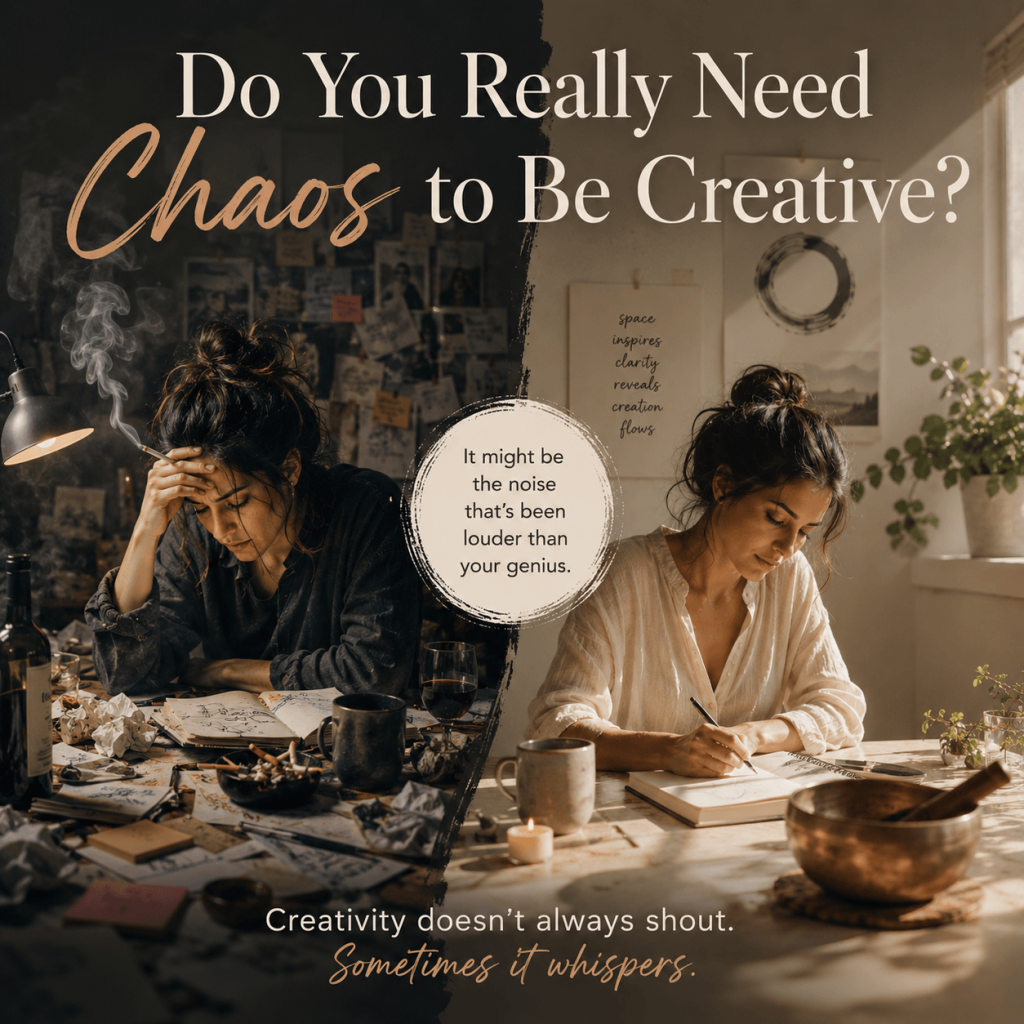
As we talked, they described a life filled with the kind of intensity we often associate with creative people—lots of energy, constant activity, emotional highs, cigarettes, alcohol, stimulation, ideas coming quickly, and a certain amount of chaos woven through all of it.
But what interested me most wasn’t the behavior.
It was the belief underneath it.
There seemed to be an assumption that this frenetic energy was part of the creative process itself. That somehow the intensity, the stimulation, and even some of the less healthy behaviors belonged to creativity. Calm things down too much and perhaps you risk calming down the very thing that makes the art possible.
I’ve encountered versions of this idea before, and I think it’s worth questioning.
What if we’re sometimes mistaking the state in which we’ve learned to create for the source of our creativity?
The Romantic Myth of the Chaotic Creative
Our culture has certainly helped reinforce the idea.
There is a long-standing mythology around the tortured artist, the unpredictable musician, the writer working through the night, or the brilliant creative person whose gifts somehow come packaged with excess, intensity, and self-destructive behavior.
Eventually, those things can become strangely intertwined.
Creativity becomes associated with chaos.
Intensity becomes associated with inspiration.
And regulation can start to sound suspiciously like dullness.
I understand why someone might resist that. If your greatest ideas have historically arrived while you’re highly activated, why wouldn’t you assume activation is necessary?
But correlation isn’t necessarily causation.
Perhaps creativity was happening alongside the frenetic energy rather than because of it.
Your Nervous System Learns the Conditions You Repeatedly Give It
Our brains and bodies are extraordinarily good at making associations.
If you repeatedly write late at night with a stimulant in your hand, music playing, several ideas competing for your attention, and your body buzzing with stimulation, those conditions can eventually become part of your internal signal that says, Now we create.
The ritual becomes familiar.
So does the physiological state.
Over time, it can become difficult to imagine accessing creativity without recreating the conditions that have accompanied it.
But that doesn’t necessarily tell us where creativity originates.
It may simply tell us how we’ve trained ourselves to access it.
That’s an important distinction.
Activation Isn’t the Enemy
I wouldn’t argue that creative people should become calm all the time. In fact, that would misunderstand nervous-system regulation entirely.
Creativity often contains enormous energy.
There’s excitement when an idea appears. There’s urgency when something wants to be expressed. There can be periods of intense concentration, experimentation, risk-taking, playfulness, and momentum.
Those aren’t things we need to eliminate.
A healthy nervous system isn’t permanently serene. It’s flexible.
The question is whether you can access that activation and come back from it.
Can you become intensely engaged without needing to remain chronically overstimulated?
Can you generate ideas without exhausting yourself?
Can you move between imagination and stillness?
Can your creative fire burn without requiring the rest of you to burn with it?
That’s a very different conversation from simply telling creative people they need to calm down.
There May Be Creativity on the Other Side of the Noise
One of the things I’ve learned through my work with sound is that stillness doesn’t necessarily make people empty.
Quite often, it reveals what was difficult to hear before.
When the nervous system begins to settle, the constant scanning and mental chatter can soften. Attention can become less fragmented. Subtle sensations become easier to notice. Thoughts that were competing with dozens of other thoughts have more room to develop.
And sometimes something unexpected emerges.
An image.
An idea.
A realization.
A connection between two things that hadn’t previously seemed related.
That’s creativity too.
It just doesn’t always arrive with fireworks.
There is a quieter form of creativity that comes through receptivity rather than intensity.
Instead of chasing the idea, we become available to it.
When a Nervous-System State Becomes Part of Identity
This is where I think the conversation becomes particularly interesting.
We don’t just develop habits. We develop stories about those habits.
“This is how I work.”
“I’ve always been high-energy.”
“My mind is just crazy.”
“I need that edge.”
“That’s part of being creative.”
Once a nervous-system state becomes woven into identity, changing it can feel like losing something much more important than a habit.
If I become calmer, will I still be interesting?
Will I still have ideas?
Will my work lose its edge?
Will I still recognize myself?
Those aren’t trivial questions.
And I don’t think the answer is to strip creative people of intensity. It is to become curious about whether intensity is the only doorway they’ve learned to use.
What If Regulation Gives Creativity More Range?
I sometimes think about nervous-system regulation as increasing the number of rooms we’re able to enter.
Activation is one room. It’s valuable. There may be enormous energy, spontaneity, courage, and momentum there.
But there are other rooms.
Stillness can give us access to nuance.
Rest can create space for integration.
Slower states can allow ideas to develop rather than immediately demanding that we act on them.
Quiet can help us distinguish an interesting idea from simply another loud one.
And greater regulation may give us something particularly valuable: the ability to choose the state that serves the work instead of needing a particular state in order to work at all.
That doesn’t sound like less creativity to me.
It sounds like more creative freedom.
Maybe the Fire Was Yours All Along
I think this is the question I’d invite any highly creative person to consider.
What if the frenetic energy you’ve associated with your creativity isn’t actually where your creativity lives?
What if the emotional swings weren’t creating the ideas?
What if the alcohol wasn’t creating them?
What if the chaos wasn’t creating them?
What if you were?
Perhaps those things simply became familiar companions to a creative capacity that belonged to you all along.
And if that’s true, calming your nervous system doesn’t mean extinguishing the fire.
It may simply allow you to discover how many different ways that fire can burn.
If you’ve spent years believing that stress, intensity, or constant motion is simply part of who you are, your nervous system may need more than the instruction to “calm down.” It may need repeated experiences that show your body another way of being—without asking you to give up the energy, creativity, or spark that makes you you.
The Monday Reset is a 30-minute online sound and guided meditation experience designed to help your nervous system practice exactly that. A little less noise. A little more space. And perhaps the discovery that becoming calmer doesn’t mean becoming less of yourself—it may give you greater access to who you already are.