

There are moments when the mind feels less like a quiet place to think… and more like a room full of tabs left open.
You try to focus, but your attention keeps shifting.
You try to relax, but your thoughts keep circling back.
You finish one task only to immediately begin mentally rehearsing the next five.
For many people, this constant mental activation has become so normal that they no longer recognize it as nervous system overload.
They simply call it:
- stress,
- overthinking,
- anxiety,
- mental exhaustion,
- or “being wired all the time.”
But often, what’s happening beneath the surface is that the nervous system has become stuck in a state of heightened vigilance.
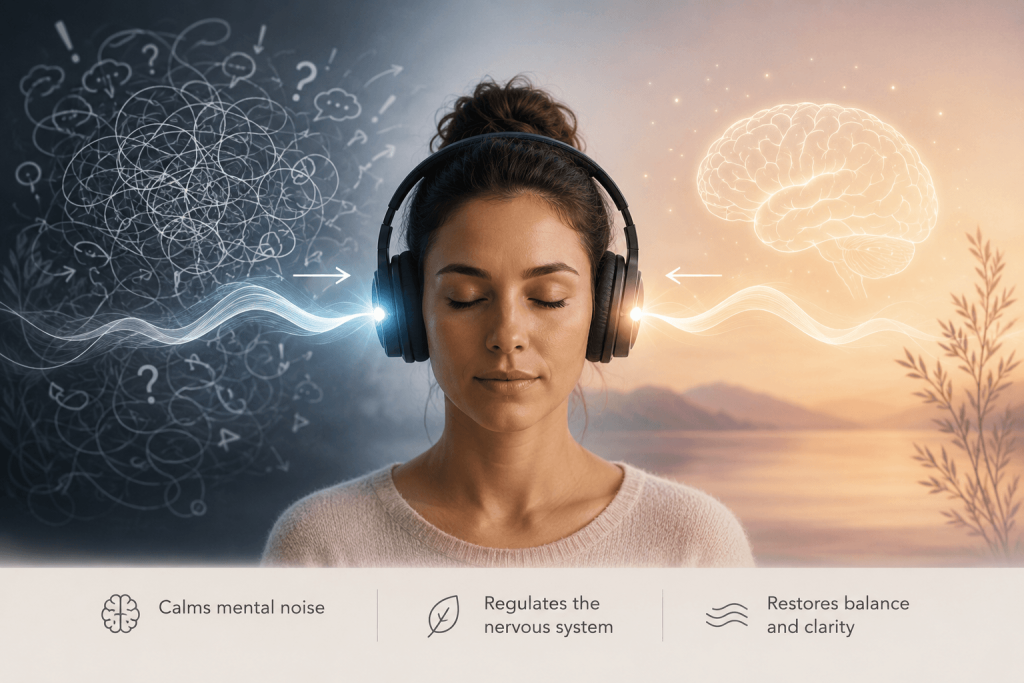
And this is one reason bilateral music stimulation has been gaining attention for its calming effect on the brain and body.
What Is Bilateral Music Stimulation?
Bilateral music stimulation uses alternating sound patterns that gently move from one side of the body or auditory field to the other.
This can happen through:
- headphones,
- panning sound between left and right ears,
- alternating rhythmic tones,
- or layered music designed to shift attention back and forth in a steady, predictable way.
You may have heard bilateral stimulation discussed in connection with EMDR therapy, where alternating sensory input is used to support emotional processing and nervous system regulation.
But bilateral sound stimulation is also increasingly being explored in relaxation practices, meditation, focus support, and sensory regulation.
The reason appears to be connected to how the brain responds to rhythm, predictability, and shifting attention.
Why an Overactive Mind Often Struggles to Slow Down
When the nervous system perceives stress — even subtle, chronic stress — the brain begins prioritizing scanning, monitoring, and anticipating.
In other words, it becomes more difficult to fully settle.
This can show up as:
- looping thoughts,
- difficulty concentrating,
- racing mental activity,
- emotional reactivity,
- shallow breathing,
- tension in the jaw, chest, or shoulders,
- or the strange feeling of being exhausted while simultaneously unable to relax.
From a nervous system perspective, this state is not a personal failure.
It is often an adaptive response.
The brain is attempting to stay prepared.
The problem is that many people rarely experience enough sensory safety for the system to fully downshift.
This is where sound can become powerful.
Why Alternating Sound Feels Calming
The nervous system is constantly responding to sensory information.
And unlike analytical thinking, sound does not require effortful processing to affect the body.
Rhythm, tone, repetition, and spatial movement can influence:
- attention,
- breathing patterns,
- emotional state,
- and physiological arousal.
With bilateral music stimulation specifically, the gentle left-right alternation appears to give the brain something structured and rhythmic to follow.
For many people, this creates several effects simultaneously:
1. It interrupts cognitive looping
An overactive mind tends to recycle the same internal patterns repeatedly.
Alternating sound introduces an external sensory rhythm that can softly redirect attention away from repetitive thinking.
Not by force.
But by giving the nervous system another place to orient.
2. It creates predictability
The nervous system relaxes more easily in the presence of predictable patterns.
Steady alternating sound can create a subtle sense of order and containment, particularly for people who feel mentally scattered or overstimulated.
3. It shifts awareness from thinking into sensing
Many people live almost entirely “from the neck up.”
Bilateral sound often helps awareness move back into the body:
- breathing becomes more noticeable,
- tension becomes easier to feel,
- and mental intensity may begin softening naturally.
This sensory shift matters because regulation does not happen through thinking alone.
The body has to experience enough safety to let go.
Why Bilateral Music Stimulation Feels Different Than “Trying to Relax”
One reason people struggle with relaxation is because they approach it cognitively.
They try to think themselves calm.
But the nervous system responds more directly to experience than instruction.
This is why practices involving:
- rhythm,
- sound,
- movement,
- breath,
- and sensory awareness
can sometimes help more effectively than simply telling yourself to “stop worrying.”
Sound gives the body something to experience rather than something to solve.
And for people carrying chronic mental tension, that distinction can feel surprisingly relieving.
The Goal Is Not to Shut the Mind Off
A regulated nervous system is not empty or emotionless.
It is flexible.
The goal is not to eliminate thought.
The goal is to help the body move out of constant internal vigilance so the mind no longer has to work so hard to maintain control.
This is why many people describe bilateral music stimulation as:
- grounding,
- focusing,
- emotionally soothing,
- or mentally spacious.
Not because thoughts disappear completely…
…but because the nervous system no longer feels as trapped inside them.
A Gentle Reminder About Sound and Healing
Not every sound experience affects every person the same way.
And bilateral music stimulation is not a replacement for medical or mental health care.
But many people are discovering that sound can become a supportive tool for:
- calming mental overload,
- reconnecting with the body,
- improving focus,
- and creating moments of nervous system relief in a world that rarely slows down.
Sometimes healing does not begin with “fixing” the mind.
Sometimes it begins by giving the nervous system a different rhythm to follow.
Experience Nervous System Support Through Sound
Curious what bilateral sound stimulation actually feels like?
Try this free 4-minute audio experience designed to gently engage the nervous system through alternating sound patterns often associated with focus, calming, and emotional processing support.
Headphones recommended. https://aurras.com/free-bilateral-meditation/